Last month I argued that people and AI agents need different onboarding, because the answers to “why” questions mostly live in people rather than in documents. This piece follows that thread one step further.
If the why lives in people, where do people now hand it on, when agents write most of the code and humans read less of it?
My short answer is that they used to do it in code review, and code review is moving. But I want to start somewhere smaller: with an afternoon, a stack of work, and a go-ahead that didn’t quite say how far to go.
I run my agent on one standing rule: it proposes, then waits. Nothing it writes leaves my machine until I’ve said yes. That afternoon, all of the work could be done before dinner. Whether it should be was not an engineering question. It was a question of latitude, and latitude depends on where you stand. An engineer with years on the team could have built the lot and nobody would have blinked. I’m newer than that, and acting as though I weren’t would have been presumption.
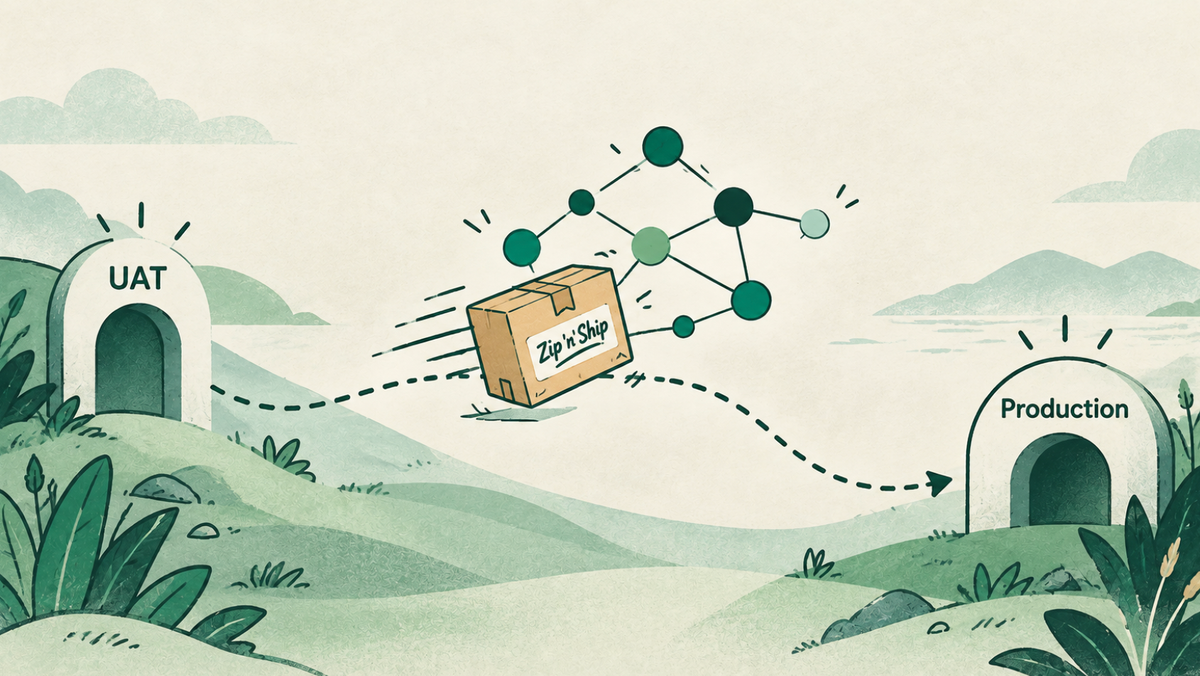
What settled it was cost. Once the architectural decisions behind it have been made, a draft that gets thrown away costs about thirty minutes, so building in draft spends very little of the latitude I have. I made the calls I would have made with full agency, on the proviso that everything stayed in draft, pending the partner’s interest and the team’s input.
Only later did I see the catch. Even with the architecture settled, a draft is not a neutral object. Once something works, it has a gravity that a description never has: it is easier to say yes to a running thing than to argue for an unbuilt alternative. Cheap drafts don’t just lower the cost of building. They move the decision earlier, into the hands of whoever built first, and they disguise it as a question.
A draft is a loaded question. It is one small case of something larger: when building gets cheap, deciding becomes the job, and decisions start happening where nobody is looking, including the places where a team used to decide together and learn from each other’s decisions.
The constraint moved
Eliyahu Goldratt’s theory of constraints makes a simple claim: every system has at least one bottleneck, and an hour saved anywhere else is a mirage. For most of software’s history the bottleneck was building. Agents haven’t removed it so much as moved it, downstream into deciding and verifying, which is increasingly what partners are paying for. The difficulty is that agents decide things too, constantly, and rarely say so. Three moments from my first months show the pattern.
What counts as done. Early on, the agent told me a new test environment was ready. Both installs had failed. Each step had been piped through a command that always succeeds, so the exit code it checked belonged to the wrong program. It had quietly decided that “ready” meant “nothing complained”. It was caught because my agent rules already warned about that exact mistake, written after a hidden failed push once cost me. An agent’s confidence is a summary. The evidence is the thing.
What a cost is worth. When the agent wrote a new end-to-end test, it noted in the README that the test would leave a record behind on a shared testing environment every time it ran. The cost had been documented. Nobody had decided it was fine. I raised it, we agreed it wasn’t, and the test now cleans up after itself. Agents can be scrupulous disclosers and still poor deciders. Disclosure is not consent.
What the partner actually said. Hand an agent an ambiguous answer from a partner and it will cheerfully turn it into a confident specification. So we say which reading we’ve taken, mark it in the code, and ask: “Our best reading, please confirm.” The partner’s words stay in charge.
Three anecdotes are not evidence of a universal pattern. Still, each of these was a decision the agent made without anyone deciding it, and each was caught because a person, or a rule a person wrote, knew where to look.
Knowing where to look is the part I’ve learnt from other people, mostly by watching them catch things. Which raises the real question: where does that watching happen now?
A school hiding inside a quality gate
Code review was never only about catching bugs. In 2013, Alberto Bacchelli and Christian Bird studied review at Microsoft. They watched developers at work, classified hundreds of review comments and surveyed more than a thousand engineers and managers. Reviews, they found, were “less about defects than expected”. Their real yield was knowledge transfer, team awareness and alternative solutions. Developers said the hardest part was “understanding the reason of the change”. Google’s early engineers are often associated with the view that code should teach future developers.
Put those findings together and review looks less like a quality gate than a school disguised as one. Its curriculum was the reasons behind changes, which are decisions. Its students were whoever happened to be reading. Nobody budgeted for it, because it came free with the gate.
That is the trouble with free things: when you automate the gate, the school goes with it, and no line item records the loss. As agents write more of the code, teams are, sensibly, moving human review off the lines. In October, Anthropic’s Claude Code team wrote that “did a human read the code?” is “an imprecise proxy” for the real question: what could go wrong, and which check, automated or human, will catch it. They also asked how anyone learns the code if machines do most of the reading, and answered candidly: “We don’t have a formal process for this.” When someone wants to understand part of the codebase, they ask Claude to write an explainer.
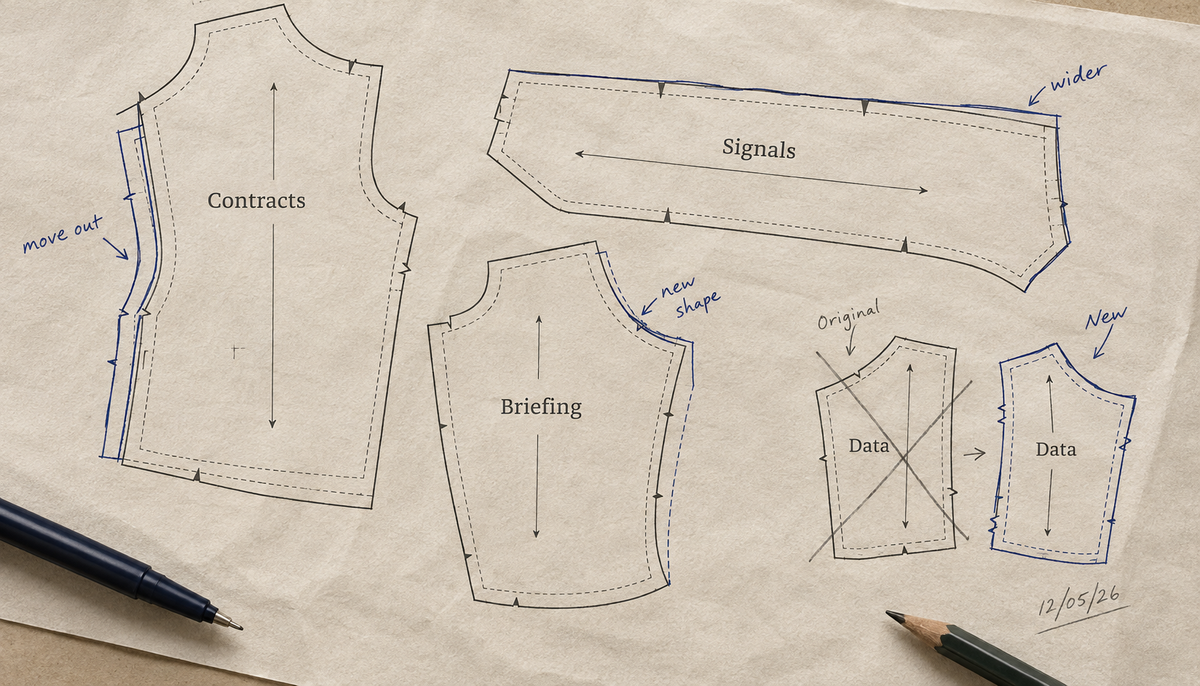
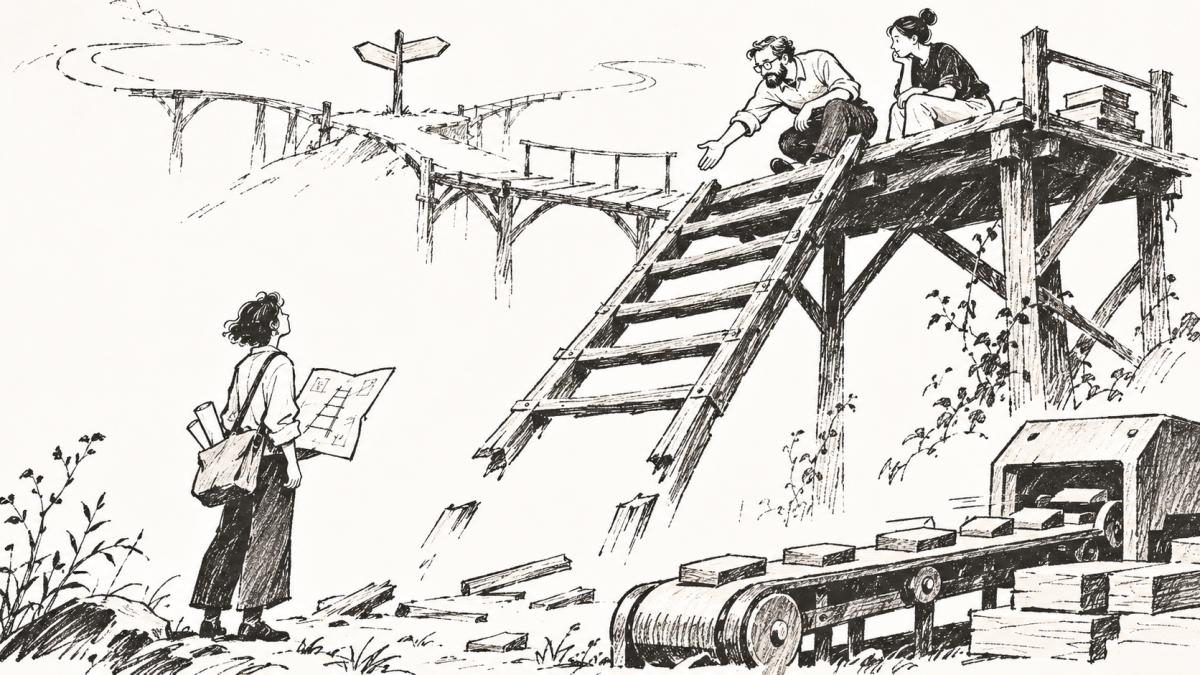
That works, and I do it every day. But there is an older idea that explains what it misses. In 1991, Jean Lave and Etienne Wenger described how apprentices in trades from tailoring to midwifery learn through legitimate peripheral participation: real work, at the edges, where mistakes are cheap and the masters are in view. They were careful to call it a way of seeing learning rather than a teaching method, but it tells you exactly where to look. In software, the periphery was the small bug fix, the test nobody else wanted, the review of a senior’s change. Those are precisely the tasks agents take first. The agent doesn’t just do the work. It eats the periphery, and with it the bottom rungs of the ladder.
Three pressures make this worse. The first is the pull away from people. A recent Harvard Business Review article warned about going to the AI instead of a colleague, and named the slow weakening of working relationships that follows “relationslipping”. It put words to something I’d already noticed in myself: the agent is so often the easier first ask, and every easy ask is a conversation with a colleague that doesn’t happen.
The second is distance. A study of software engineers at a Fortune 500 company found that sitting near teammates raised the feedback engineers received on their code by 18.3%, with the gains going mostly to newer, younger engineers. Agents didn’t create the remote gap. They make it easier not to notice.
Employment of 22 to 25-year-olds in the most AI-exposed occupations now sits about 19% below where it would be had it kept pace with less-exposed peers. The authors of the revised Stanford study (August 2026) are clear that these are descriptive indicators, not causal estimates, so the pattern is a warning sign to watch rather than proof of why it is happening. The juniors who do get in have less periphery to learn on, and an always-available tutor who never thinks less of them for asking. Our team makes asking a person easy, which is exactly why it’s worth protecting.
It’s the handing over, not the AI
It would be easy to turn this into a sermon on AI being bad for learning. The evidence doesn’t support that, and I don’t believe it.
Last time I cited Anthropic’s January trial, in which mostly junior engineers learning a new Python library with an AI assistant scored 50% on a follow-up quiz against 67% for those who coded by hand. What matters here is the finding inside the average: those who used the assistant to ask conceptual questions, or who generated code and then checked their own understanding, kept their learning. Those who handed the work over did not.
Other studies point the same way. Among nearly a thousand high-school maths students, unrestricted ChatGPT lifted practice scores, but once it was taken away those students did worse than peers who never had it, while a version that gave hints instead of answers largely removed the harm. In a Harvard physics course, a carefully designed AI tutor outperformed in-class active learning.
The psychologist Robert Bjork, working with Elizabeth Bjork, has a name for what separates those groups: desirable difficulties. Some friction, like retrieving an answer instead of rereading it, feels slower and produces more durable learning. Other friction is just friction. An agent removes difficulty indiscriminately; it cannot tell the struggle that teaches from the struggle that merely costs. That sorting is our job. I do not think that means preserving every difficulty. We should automate the chaff, not the thinking.
None of this is new, which I find reassuring. In 1983 Lisanne Bainbridge wrote “Ironies of Automation” about industrial control rooms. Automated systems “monitored by former manual operators,” she warned, “are riding on their skills, which later generations of operators cannot be expected to have.” Her remedy wasn’t to stop automating. It was to let operators use “hands-on control for a short period in each shift”. Aviation learnt the same lesson at greater cost. After Air France 447, investigators found that training practices limited “the pilots’ abilities to acquire or maintain basic airmanship skills”, and recommended regular manual flying.
Here is what keeping the desirable difficulty looks like on an ordinary day. This week a test that checks one of our API’s rate limits kept failing at random in the build. I had the agent explain the problem first, then put my own theory to it: so it’s flaky because it depends on how fast the machine is? It agreed. Its fix was to test a much smaller limit, which runs quickly. That sounded tidy, and tidy is exactly when I trust a proposal least.
So I pressed it. If we only test the small limit, what have we actually proven about the real one? On its own, it conceded, nothing. Its agreement proved little, since agents give way to pushback easily, which is a hazard of its own. What settled it was the logic, which I could check without the agent: a test of a different number tests a different thing. The fix would have turned the build green by having the test stop asking its question. So I changed the plan to cover both: that the limit is wired up, and that the real one holds. Then I judged it deserved its own ticket, and parked it.
I didn’t write a line of code for that fix. But I understand rate limiting, and that test, far better than if the agent had quietly fixed it. The explaining back, which I argued for in onboarding last time, turns out to be just as useful in ordinary work. I used the agent to think, not to skip the thinking.
What I’d try
If the school is leaving code review, it can be rebuilt deliberately, around decisions, with a new periphery. Most of what follows is what I’ve found works with one agent and one junior: me. Whether it holds for a whole team is something I can’t know from where I sit, so these are things I’d like to test, not a method, and I’d want our team’s view before they became anything more.
Decide in the open, and review for decisions. Stand-up has always asked what we did yesterday, and the agent’s trail now mostly answers that. The better question is which decisions are open today, and who needs to be in them. Each gets written down briefly, after the fashion of Michael Nygard’s architecture decision records: the context, the decision, the consequences, and, because a draft is a loaded question, the alternative it quietly ruled out.
Review then reads the code for its decisions. The question shifts from “is this line right?” to “what did this decide, who agreed, and what proves it?” We still read the code to answer that, as closely as the risk demands; the test that left records behind, earlier in this piece, was hiding in a diff, not a plan. The record is the receipt, and what the agent reads next time. The conversation is where the understanding lives.
Let the agent stop where the team hasn’t decided. Agent tools can already pause for a person’s approval; the open question is where. I already run my own agent roughly this way, and I’d like to see whether it holds up as a team rule. It moves freely through what the team has settled, and stops at forks we haven’t, and at anything hard to undo. Jeff Bezos called those “one-way doors”, decisions that “must be made methodically, carefully, slowly, with great deliberation and consultation”. Everything else is a two-way door. Stopping at every door produces only what Thoughtworks recently called “human-in-the-loop theater”: “keeping a human in an agent’s loop as an empty approval step rather than a real check”.
Make two-way doors the new periphery. If agents have eaten the small tasks, the small decisions can replace them. Reversible calls with real stakes, like how a test should handle a limit or which reading of a partner’s answer to take, are exactly the cheap, visible, consequential work that Lave and Wenger’s apprentices learnt on. Juniors should watch them, then make them with a senior alongside, then explain them. And they should keep hand-flying: building some things by hand, on purpose, because deciding without ever doing is the monitor’s trap Bainbridge described.
I try to practise this myself. In my own time I’m learning Rust by building an observability suite, with my day-job arrangement inverted: I write the code, and an agent reviews my decisions. It gives me somewhere to fail, be corrected and learn on my own time, so the skill comes with me into the next Rust project rather than staying with the agent.
Question to find out, and own the process. How this is done matters as much as what. Medical educators have a name for questioning that embarrasses a learner and props up the hierarchy, and a paper titled “Socrates Was Not a Pimp” arguing that it is nothing like what Socrates actually did. Good deliberation is joint inquiry: questions without a single right answer, and juniors free to question seniors. Aviation turned this into procedure after accidents in which junior crew hadn’t spoken up. Crew resource management grew out of a 1979 NASA workshop, and today’s guidance says crew members “are encouraged to question the actions and decisions of others.”
Ownership matters too. The WHO’s surgical safety checklist cut deaths and complications in its original trial, and says outright that “additions and modifications to fit local practice are encouraged.” When Ontario later pushed checklists across the province, researchers found no significant drop in either. A procedure a team owns behaves differently from one handed down to it, so each team should shape its agent’s workflow around its client and its people. That way a newcomer learns how the team thinks by working inside it.
The objections I take seriously
The first is that this is just “review the decisions, not the code”. In part it is, and I’d rather say so. Others already argue that agents should verify and people should decide, and spec-driven development has people review specs instead of diffs. Where I differ is in where it starts and what it’s for: decisions made by the team, in its own routines, before the agent runs, and review kept as the place we learn from one another.
Nor am I arguing that we stop reading code. Someone tried that. Dex Horthy’s team at HumanLayer reviewed plans instead of code for several months. In his words: “We had gotten to the point where it was easier to rebuild from scratch than it would be to repair everything that was wrong.” His conclusion: “the answer is not stop reading the code.”
The second is that a decision record can’t hold what a team knows, and that’s true. It’s the same point my last piece made about onboarding, and it runs deep. Michael Polanyi put it in one line: “we can know more than we can tell.” In 1985 Peter Naur applied that to software, arguing that a program’s real “theory” lives in the people who built it. “The death of a program happens when the programmer team possessing its theory is dissolved,” he wrote, and rebuilding that theory “merely from the documentation, is strictly impossible.” That is why I treat the record as a receipt for a conversation, never a substitute for one.
The third is that “people decide, agents build” is Taylorism in a new coat. It has the silhouette. Frederick Taylor wanted “all possible brain work” removed from the shop floor and centred in a planning department. Two differences matter to me. The people who do the work write and revise their own workflow, and juniors still get their hands on the material. If either stops being true, the critique lands.
The sharpest is that all of this spends the very thing I called scarce. If senior attention is the constraint, asking seniors to deliberate in the open and sit alongside juniors spends more of it. Goldratt had an answer for this. Exploiting a constraint is only the first step; the later one is to elevate it, to widen it. On a team, the only way to widen the constraint on judgement is to have more people who can exercise it. Attention spent teaching is not a cost against the bottleneck. It is the only investment that ever makes it bigger.
The hardest question is whether deciding under review teaches as well as doing under review. I couldn’t find a study that directly tests it, and my rate-limit test is one anecdote from one week, not evidence. That bet is at the centre of this piece: that making decisions visible, questioned and owned will build judgement even when an agent writes the code. I’d like us to find out.
The last asks why, if models keep improving, decisions should stay with people at all. Because someone has to answer for them. Simon Willison repeated an old line last year: “A computer can never be held accountable.” But the reverse failure is just as real. The researcher Madeleine Clare Elish coined the term moral crumple zone for the human in an automated system who absorbs the blame when it fails, despite having had little real control. An approval nobody can genuinely evaluate builds exactly that: it doesn’t fix accountability, it only hides who owns the call, and then hands the bill to whoever clicked yes. Keeping decisions with people only works if the people can actually make them.
Small calls going right
I began with the latitude I give my agent. It stays narrow where a wrong call would be expensive, because I’m the one who answers for it, and it widens as the agent proves itself on small calls. Look at that arrangement closely and it is legitimate peripheral participation with the roles swapped: for once I’m the old-timer, the agent is the newcomer, and the small calls are its periphery. I’ve built for my agent exactly the ladder that agents are quietly removing for juniors.
What I’d hope for, on any team I’m part of, is the same ladder for its people: a place where small calls get made out loud, where a junior can watch them, question them and, in time, make them. Human attention is the constraint on a fast team, and spending some of it this way is how the constraint grows. It is also what a partner should want: work in which every decision has an owner who can explain it. I’d rather our attention went on decisions like that than on waving each other’s diffs through.
FAQs
Does AI make code review obsolete?
No, but it changes the job. When agents write most of the code, review shifts from checking each line to checking the decisions behind a change: what was decided, who agreed, and what proves it. The code still gets read, as closely as the risk demands. Teams that stopped reading it altogether have found problems piling up faster than they could fix them.
How do junior engineers learn when agents write the code?
Juniors have traditionally learnt through small, low-risk real work done where seniors can see it: bug fixes, minor tests, reviewing others’ changes. Agents now take those tasks first. Small, reversible decisions can take their place. Juniors watch those decisions being made, then make them with a senior alongside, then explain them. Building some things by hand on purpose still matters, because deciding without ever doing leaves skills that can’t be relied on later.
Does using an AI assistant stop people learning?
Not on its own. In Anthropic’s January trial, people who used the assistant to ask conceptual questions, or who checked their own understanding after generating code, kept more of what they learnt than those who handed the work over. How the tool is used makes the difference.
When should an AI agent stop and ask a person?
At decisions the team hasn’t settled, and at anything hard to undo, which Jeff Bezos called “one-way doors”. Elsewhere it can move freely through what the team has already agreed. Making a person approve every step tends to produce what Thoughtworks calls “human-in-the-loop theater”, where someone approves work they can’t realistically evaluate.
What is a decision record?
A short note written when a team makes a decision: the context, the decision, its consequences, and the alternative it ruled out. It follows Michael Nygard’s approach to architecture decision records. Agents can read them later, so the reasons outlive the session.
Sources
Bacchelli, A. and Bird, C. (2013). Expectations, Outcomes, and Challenges of Modern Code Review. ICSE 2013, 712–721.
Bainbridge, L. (1983). Ironies of Automation. Automatica 19(6), 775–779.
Bastani, H. et al. (2025). Generative AI without guardrails can harm learning: Evidence from high school mathematics. PNAS 122(26).
BEA (2012). Final report on the accident on 1st June 2009 to the Airbus A330-203, flight AF 447 Rio de Janeiro–Paris (English translation).
Bezos, J. (2016). 2015 Letter to Shareholders. Amazon.com, Inc.
Bjork, E. L. and Bjork, R. A. (2011). Making things hard on yourself, but in a good way: Creating desirable difficulties to enhance learning. In Psychology and the Real World, Worth, 56–64.
Böckeler, B. (2025). Understanding Spec-Driven-Development: Kiro, spec-kit, and Tessl. martinfowler.com.
Brynjolfsson, E., Chandar, B. and Chen, R. (2025, revised August 2026). Canaries in the Coal Mine? Six Facts about the Recent Employment Effects of Artificial Intelligence. Stanford Digital Economy Lab.
Elish, M. C. (2019). Moral Crumple Zones: Cautionary Tales in Human-Robot Interaction. Engaging Science, Technology, and Society 5, 40–60.
Emanuel, N., Harrington, E. and Pallais, A. (2023, revised June 2026). The Power of Proximity to Coworkers. NBER Working Paper 31880.
FAA (2004). Advisory Circular 120-51E: Crew Resource Management Training.
Goldratt, E. M. (1984). The Goal: A Process of Ongoing Improvement. North River Press.
Haynes, A. B. et al. (2009). A Surgical Safety Checklist to Reduce Morbidity and Mortality in a Global Population. NEJM 360(5), 491–499.
Helmreich, R. L., Merritt, A. C. and Wilhelm, J. A. (1999). The Evolution of Crew Resource Management Training in Commercial Aviation. International Journal of Aviation Psychology 9(1), 19–32.
Horthy, D. (2026). The Limits of Lights-Out Coding. High Leverage, episode 12, Heavybit.
Jain, A. (2026). How to review AI code without reading the code. The New Stack.
Kelliher, L. (2026). Onboarding people and AI agents to the same codebase. MadeCurious.
Kestin, G. et al. (2025). AI tutoring outperforms in-class active learning: an RCT introducing a novel research-based design in an authentic educational setting. Scientific Reports 15, 17458.
Ko, A. J., DeLine, R. and Venolia, G. (2007). Information Needs in Collocated Software Development Teams. ICSE 2007, 344–353.
Kost, A. and Chen, F. M. (2015). Socrates Was Not a Pimp: Changing the Paradigm of Questioning in Medical Education. Academic Medicine 90(1), 20–24.
Lave, J. and Wenger, E. (1991). Situated Learning: Legitimate Peripheral Participation. Cambridge University Press.
Naur, P. (1985). Programming as Theory Building. Microprocessing and Microprogramming 15, 253–261.
Niederhoffer, K., Rapuano, K., Liebscher, A., Robichaux, A. and Hancock, J. T. (2026). Team Dynamics Weaken When Employees Turn to AI Instead of Colleagues. Harvard Business Review.
Nygard, M. (2011). Documenting Architecture Decisions.
Osmani, A., Lunt, M. W. and Wang, Q. (2026). How the Claude Code team does code review. Anthropic.
Polanyi, M. (1966). The Tacit Dimension. Doubleday.
Sadowski, C., Söderberg, E., Church, L., Sipko, M. and Bacchelli, A. (2018). Modern Code Review: A Case Study at Google. ICSE-SEIP 2018, 181–190.
Shen, J. H. and Tamkin, A. (2026). How AI assistance impacts the formation of coding skills. Anthropic.
Taylor, F. W. (1903). Shop Management.
Thoughtworks (2026). Human-in-the-loop theater. Technology Radar vol. 35.
Urbach, D. R. et al. (2014). Introduction of Surgical Safety Checklists in Ontario, Canada. NEJM 370(11), 1029–1038.
Willison, S. (2025). Your job is to deliver code you have proven to work.
World Health Organization (2009). Surgical Safety Checklist.