What the court actually decided
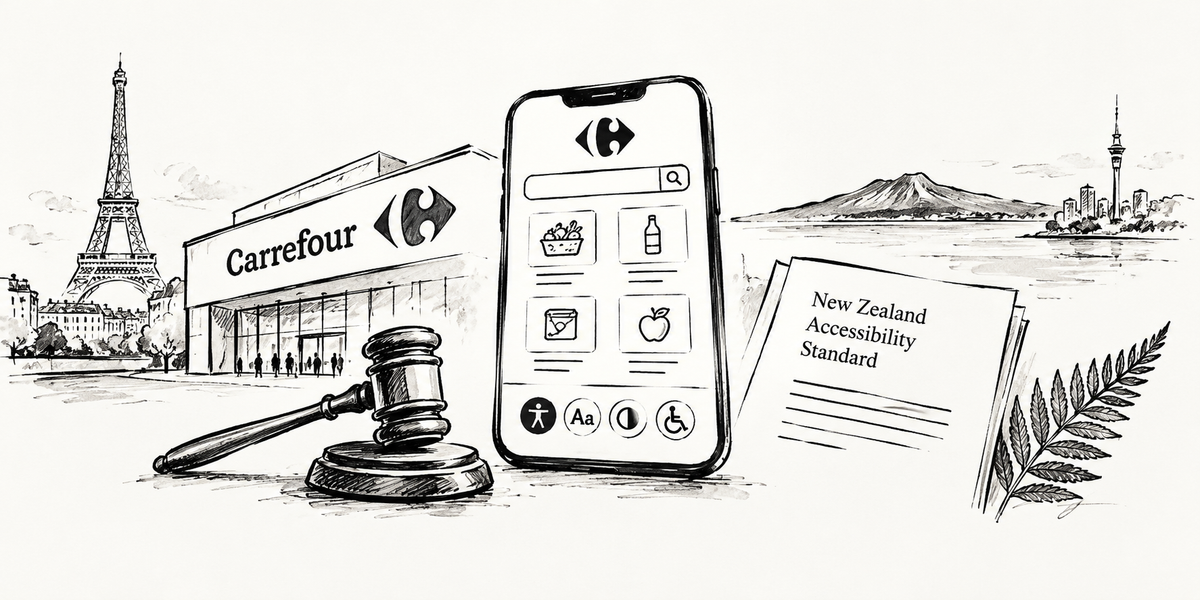
In June, a court in Caen made an interim order requiring Carrefour France to make its online shop and app fully accessible. Carrefour has six months. After that, a penalty payment of €500 applies for every day it's late. It's one of the first court orders enforcing France's version of the European Accessibility Act, and it has been doing the rounds in accessibility circles ever since. It's worth being clear about its weight: even in France it is an interim, first-instance decision, and it binds only Carrefour.
What caught my attention was the argument Carrefour lost. Its own accessibility statement put its conformance at 71% under RGAA, the French framework the court accepted as a way to assess conformity with the European standard, EN 301 549. Carrefour argued that an overall assessment, based on whether disabled people could actually use the service, was enough on its own. The judge rejected that. The site couldn't be only a little bit accessible, she wrote. It had to be fully accessible.
I'll admit my first reading of this case started from a different place. I assumed it was a story about real users beating checklists, because that's the story our industry tends to tell. The judgment says something much less comfortable. In this case, a usability argument didn't buy Carrefour out of the criteria. The law does allow narrow exceptions, such as a disproportionate burden (and Carrefour tried that too), but the judge wasn't persuaded on the evidence. My own view goes further than the ruling: the criteria are the floor, and "most people can manage" isn't a winning argument against them.
Even though this is France, I think the decision matters here: New Zealand's draft standard points in the same kind of direction.
Winning in court, failing the customer
A month before Caen, a court in Lille ruled on a near-identical complaint against Auchan. Both cases came from the same campaign: in July 2025, apiDV and Droit Pluriel sent formal notices to four of France's biggest grocery retailers.
Auchan won the interim hearing, and how it won is the interesting part. The court accepted that Auchan's online shop didn't meet accessibility standards (Auchan didn't argue otherwise), and the judge remarked on the company's evident lack of interest in accessibility. But the judge read the French law implementing the European Accessibility Act as keeping an older turnover threshold in place. Auchan's online shop is run by a subsidiary that sits under that threshold, so the court found no obligation applied and refused interim relief. It didn't find the shop accessible. It just found the law didn't reach it. It's worth noting that the associations dispute that reading and have appealed.
Two caveats matter; both rulings were interim decisions, not final judgments. And Carrefour is big enough to be caught under either reading of the law, so the cases don't squarely contradict each other. Neither ruling settles the law in France, let alone across the EU.
My legal background probably makes this kind of scenario disproportionately interesting to me. I can get on board with the idea that others might not find it so curious, or might struggle to see the relevance from sitting here safely in NZ. But how strange is it that whether Auchan had to serve blind customers comes down to which company in the group runs the website, and how much it turns over? Nothing in that test asks whether a person can buy their groceries. When compliance and accessibility come apart like that, the customer is the one left standing, unserved.
Where New Zealand sits
It's worth being careful about jurisdiction, because the two systems were built from opposite ends.
The European Accessibility Act reaches private businesses that sell consumer services, such as online shops, to people in the EU, wherever the business is based. Micro-enterprises providing services (fewer than 10 staff, with annual turnover or balance sheet of no more than €2 million) are exempt. There are also narrow exceptions where compliance would fundamentally alter a service or impose a disproportionate burden. The technical bar is the European standard EN 301 549. The version that currently carries legal weight maps to WCAG 2.1 Level AA; a new version based on WCAG 2.2 was published in September but has not yet been cited in the EU's Official Journal.
New Zealand's Government Web Accessibility Standard has required WCAG 2.2 Level AA since March 2025, but only for web pages run by Public Service departments, the Defence Force, Police, the Parliamentary Counsel Office and the Security Intelligence Service. Councils and the wider public sector are encouraged to meet it, not required to. Private businesses have no equivalent accessibility standard, though the Human Rights Act's general prohibition on disability discrimination in providing goods and services still applies.
That may be about to change shape. A consultation draft of a new Digital Accessibility Standard, with a final version due in early 2027, proposes replacing it. Its core technical requirement is EN 301 549, the same standard behind the EU law, alongside New Zealand-specific rules on planning, accessibility statements and reporting. It would cover apps, documents and software as well as websites, require a mix of testing that includes testing with disabled people, and require mandated agencies to build compliance into their ICT contracts. Which agencies must comply, and from when, is still being confirmed. For suppliers like us, that procurement clause is the part to watch.
So our public sector looks set to build on the European standard, while our private sector still has no mandate at all. A lot of the accessibility work happening in New Zealand happens because someone decided it should. (If you want the detail on what WCAG 2.2 changed, Andrew Pitts has written it up here.)
Some must, some choose
We see both sides of that in our own work.
Some of our clients must. When we built Stats NZ's place and ethnic group summaries, the tool New Zealanders use to explore census data about their communities, accessibility wasn't negotiable, and Stats NZ had the work independently audited by Intopia. It was hard. Census data is dense, much of it lives in charts and tables, and making that usable with a screen reader or a keyboard is real design and engineering work, not a styling pass at the end. It's also exactly the kind of service the standard exists for. If you can't read your own community's data, you've been left out of a conversation about you.
Others choose to. Our local iwi set WCAG 2.2 AA as a requirement in their work with us, and describe it as an expression of manaakitaka. Accessibility testing evidence is a deliverable, the same as working code. No accessibility law requires this of them. It comes from a view about how you look after the people who come to you, and it's one of the clearest statements of the intent behind the law I've read, from an organisation that law doesn't reach.
For what it's worth, we see the same thing with not-for-profits. They often have the tightest budgets of anyone we work with, and the firmest sense that leaving people out isn't an option.
Why it should matter to everyone else
If you run a New Zealand business that sells online, don't assume the European Accessibility Act applies just because Europeans can visit your website. It reaches covered services you actually provide to customers in the EU. Either way, it's still worth reflecting on the Carrefour ruling.
Partly because standards travel. WCAG 2.2 became an ISO standard in 2025, the European standard has just been updated to it, and our own government's draft standard builds on the European one. Suppliers to government are likely to feel this first.
But mostly because Carrefour shows what happens when accessibility becomes just a percentage to argue about. 71% sounds respectable in a status report. But it's a share of audit criteria met, not a share of the site that works for real humans in the real (digital) world. Among the failures the court listed were form fields with no labels and interface elements a keyboard can't reach. For someone who can't use a mouse, that's a checkout they can't finish. Treating 71% as good enough dismisses how hard the digital world already makes things for disabled people. It also leaves a paying customer unserved.
The organisations we work with that do accessibility work well don't argue about the percentage. They aim for full conformance, test with real assistive technology and real people, and ask for the evidence. When it's hard, and on data-heavy services it often is, they go ahead and do it anyway.
If you're wondering where your own service sits, ask two questions. Does it meet every criterion? And can someone using a screen reader or a keyboard, or someone with limited dexterity using a phone, get all the way to the end? You really need a yes to both.
Carrefour has six months and €500 a day to focus their minds. Most New Zealand businesses have no deadline and no one watching. But I'd be delighted if a few more of them saw that as a reason to start, not a reason to wait.
FAQs
Does the European Accessibility Act apply to New Zealand businesses?
It can. The Act covers in-scope consumer services, such as online shops, sold to people in the EU, wherever the business is based. Microenterprises providing services are exempt, and narrow exceptions apply for disproportionate burden or fundamental alteration. A New Zealand business selling only to New Zealand customers is outside it. (Directive (EU) 2019/882, Articles 4(5) and 14.)
What accessibility standard do New Zealand government websites have to meet?
Today, the Government Web Accessibility Standard 1.2 requires WCAG 2.2 Level AA, effective 17 March 2025, for web pages run by Public Service departments, the Defence Force, Police, the Parliamentary Counsel Office and the Security Intelligence Service. A consultation draft of a Digital Accessibility Standard, due in final form in early 2027, proposes replacing it, with EN 301 549 as its core technical requirement.
What did the court order Carrefour to do?
In an interim ruling on 4 June 2026, the Caen Judicial Court ordered Carrefour France to make its online shop and mobile app comply with French accessibility law. A penalty payment of €500 a day applies from six months after the order.