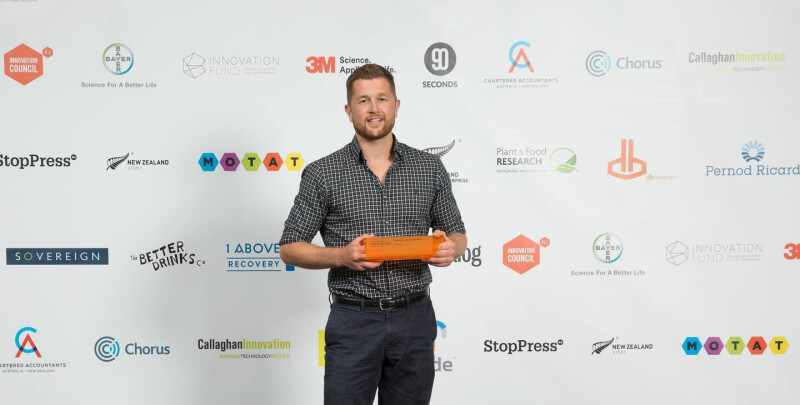
Adam Hutchinson grew up in rural Whanganui where he spent a lot of his free time trading ideas on ways to improve the farm with family friend and early mentor Kellick Harding.
He said the pair would come up with a range of ideas and bounce them off each other, giving critical feedback and refining their concepts.
“A lot of them were terrible ideas, of course, but the bigger thing that was doing was giving me the confidence that it wasn't just a silly thing for a kid to be coming up with these ideas. An adult was validating a lot of these ideas and that, in the long run, gave me a bit of confidence.”
These brainstorming sessions became the foundation for Adam’s career as a 21st century inventor.
In the same way he spotted problems on the farm and planned ways to solve them, after graduating Lincoln University, he began to do the very same thing in the wider world.
First big idea
While Adam initially went to university to study farming, he quickly found a passion for business and made the decision to change course.
Even as a student, Adam was turning ideas into money, even off the back of a bit of fun.
He decided to ride a moped from one end of New Zealand to the other and, on the way to Cape Reinga, called Yamaha NZ to let them know his plan.
“I said, ‘Oh, I'm going to do this, would you guys give me a tshirt or something?’ They ended up giving me the scooter and they bought the footage off me too, so it actually turned out pretty cool.”
As he neared graduation, he was on the lookout for business ideas and noticed something about Kiwi culture he saw as a potential problem.
“A lot of New Zealanders, if they were in a restaurant and someone would come up and say, ‘How's your meal?’, most New Zealanders I found would go, ‘Oh, it's good’, then as soon as they walk away they were like, ‘This is terrible’.”
He realised restaurant owners were likely not getting good customer feedback and so after graduating, he set out to build and sell a way for customers to leave anonymous feedback via text message.
While he had some interest, it was 2009 and the tail end of the global financial meant restaurants were feeling the squeeze. Online reviews were also taking off all over the world.
“I worked on it for about a year before I finally succumbed to the idea that there was no business model there.”
Adam said that failure came at the perfect time as he was young with few responsibilities and, in retrospect, it taught him a huge amount.
“I probably dragged that on for six months too long because I was so scared of failing. That was probably of fairly minimum consequence, but that was six months I could have been exploring something else. I was hanging on to that idea and I didn't want to fail.”
Second big idea
While there were big learnings in that failure, Adam didn’t wallow for too long as there were plenty more ideas waiting to be brought to life.
In 2010, he picked up the phone again and ended up on the line with Peter Hyde, a compliance officer with what was then called the Ministry of Fisheries.
“Hey,” he said, “I’ve got an idea.”
Adam presented Peter with a series of mocked up screenshots for a mobile application that would help recreational fisherman easily access information about fishing restrictions and requirements.
After hearing Adam out, Peter put Adam in touch with the Ministry’s operations manager, Dale Stephens, and a few months later, the NZ Fishing Rules app was born.
That contract netted Adam a little bit of cash, which was nearly instantly sunk into Adam’s next project.
Third big idea
Around the time the Fisheries app was being developed, there was a spate of media attention on freedom campers; the messes they were making and the struggles they were facing in finding public amenities.
To Adam, this was another problem that could be solved by a good app.
He found Bruce Webster, a developer willing to work for low wages plus equity, and together they created CamperMate.
Rather than going the route of a government contract, Adam bootstrapped the product so he could wholly own it, but he did need access to councils’ information on where its public amenities could be found.
Only one problem.
“A lot of them didn't know or it wasn't recorded and so I only had about 40% of the picture, which from a tourist perspective is not great.”
But Adam had a clever solution.
“We built in a feature where we could crowdsource. If you were a tourist and you found a toilet that wasn't on CamperMate, you could add it through the app.”
He spent his evenings validating those submissions using Google Maps’ street view and over the next two years the database grew from 6,000 points, to 13,000.
Thanks to word of mouth, the app grew in popularity and Adam suddenly had the likes of Juicy Rentals in his inbox.
Fourth big idea
With his last two big ideas informed by the growth of the online world, the next one built on that experience while adding an even newer technological angle.
In April 2020, Adam was playing with a virtual reality (VR) headset and he saw the synergy the tech had with exposure therapy – if people with certain anxieties could have a completely safe place to confront their fears, they could learn to control them.
This idea became oVRcome, Adam’s current business and his most ambitious one yet.
The company sells a headset that fits most smartphones, with a special app that enables the set up to become a simple but effective VR headset.
Adam knew the approach could work and, with the right backing, scale globally.
“Going into oVRcome, it was a case of bootstrapping it for the first year, and then when we published our first clinical trial with Otago University, that was a pretty good proof point to be like, I think this is a little bit more than just an interesting idea now.”
Adam decided to go fundraising and nabbed an early angel investment from the man who bought CamperMate, THL’s Grant Webster.
With that vote of confidence, he then pitched a range of angel investors, including at an Angel HQ pitch day, and soon the company had raised a pre-seed round that gave it enough capital to get things moving.
oVRcome’s first approach was to go direct to consumers but it has been, he said, “A continual challenge to get the balance right of making treatment low cost and accessible, and keeping the lights on.”
They recently expanded capabilities so they can begin selling to psychotherapy practitioners, which had a bit of a rocky start.
“Thankfully there are thousands and thousands of clinical psychologists. We burned a few at the start because the product was not where it should have been but thankfully, we’ve made it a lot better now. We've got Stanford using it, we've got Canterbury University using it, we've got clinicians in about 64 countries that are using or have used oVRcome.”
He added the company has just started reaching into schools, hoping to expand the company’s impact even further.
With a solid new go to market model in place, the company is about to hit the gas and start truly scaling.
Adam hopes that the intense work he’s put into the company will pay off within the next five to 10 years so he can focus on family and a few passion projects, like an app that lets spearfishers know what water visibility will be like based on weather, rainfall, swell and other information.
The biggest idea
Adam said the most important thing he has learned throughout this journey is the confidence to face failure head on.
Dragging out the text message feedback app too long and the many other things he’s had to let go along the way have all given him a philosophical approach to failure that he wishes he could teach to everyone.
“No one wants to fail, but this perception of failure or this taboo or stigma of failure can dictate a lot of your decision making. Try and get okay with it and just realise that it's part of every journey … When you reach the point in your heart of hearts, realising that it isn't going to work out, don't take it beyond that just because you've got this fear of failing.”
He recognises that it’s often easier said than done, that pride and a fear of looking weak can hinder even being aware of the moment when things aren’t working out, but he said it’s a lesson well worth learning.
How did Adam learn to conquer that fear? The same way that most people learn to move past their anxieties:
“I've failed a lot, so maybe it’s been a form of exposure therapy.”