A while back, I was chatting with a friend when she said something that completely changed the way I think about imagination.
We were talking about some designs I was working on, and I said something like, “You know, picture this…” setting up a scene the way I often do when describing a design idea. She nodded, then paused for a second and asked, totally serious:
“Wait, when people say ‘picture this,’ do they actually mean they can see it? Like, in their heads?”
I laughed, thinking she was joking. “Yeah… that’s what it means,” I said.
Her eyes widened.
“You’re kidding. I thought that was just a figure of speech! I don’t see anything in my head, it’s just blank.”
I’ll be honest, I was floored. I’d never really questioned the assumption that everyone could conjure up mental images. But she couldn’t. Not even faint outlines or shapes. If you told her to imagine a sunset, she didn't see colours or a horizon, she just knew what a sunset was.
That was the first time I heard about aphantasia, the inability to visualise mental images.
Psychologist and neurologist Adam Zeman at the University of Exeter first coined the term aphantasia in 2015 after studying people who reported a complete lack of mental imagery.
And learning that completely reframed how I think about creativity, communication, and especially design. Because if someone can’t visualise what you’re describing, not metaphorically but literally, it changes how you collaborate, how you present ideas, and even how you empathise with others in the creative process.

Adam Zeman
What Is Aphantasia and How Does It Affect Imagination?
Aphantasia is what researchers call the absence of voluntary mental imagery. People with aphantasia can think conceptually, remember facts, and imagine ideas, but they don’t see anything in their mind’s eye.
If you ask them to imagine a beach, they might know that beaches have sand, waves, and seagulls, but there’s no internal movie playing. It’s just… knowledge, without the visuals.
Since that original study, research has suggested that around 1–3 per cent of people have aphantasia, though some estimates go higher. It’s not a disorder or a deficit; it’s simply a different way the brain processes imagination.
Here’s a quick thought experiment: close your eyes and picture an apple.
Can you see its colour? The shine on its skin? Maybe even a bite mark?
If yes, congrats, your mind’s eye is alive and well.
If not, and it’s more like the idea of an apple, you might be on the aphantasia spectrum.
(And now you’ll probably be thinking about apples for the rest of this article. Sorry.)
You’re Not Alone: A Real-Life “Aha” Moment
I later learned that my friend’s realisation wasn’t unique.
In fact, journalist Blake Montgomery described her discovery in a 2024 Guardian piece, writing: 'While working on my story, I thought, "Well, no one can really see an apple when they close their eyes. It's just a metaphor." Then I asked some friends, and most of them could.
“While working on my story,” she wrote, “I thought, ‘Well, no one can really see an apple when they close their eyes. It’s just a metaphor.’ Then I asked some friends, and most of them could.”
That moment, equal parts awe and disbelief, perfectly captures what it’s like to realise your brain works differently from everyone else’s.
The Guardian, 2024
For people like my friend and that writer, it’s not about a lack of imagination. It’s about imagination that operates in words, concepts, and emotions instead of pictures. Their creativity isn’t less vivid, it just takes a different shape.
Why Aphantasia Matters in Design and Collaboration
Design is a deeply visual profession. We sketch before we code, storyboard before we animate, visualise before we build. It’s second nature to describe ideas in pictures: “imagine this,” “see it like that,” “picture the flow.”
But if the person you’re speaking to literally can’t picture it, that entire communication style collapses.
Let’s say you’re presenting a concept to a client with aphantasia. You say:
“Imagine a clean, minimalist layout with a soft colour palette and a subtle hero animation.”
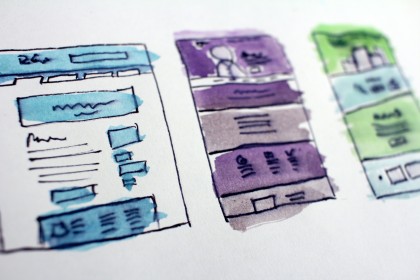
They nod politely, but they’re hearing abstract words without visuals. Until they see something concrete, a wireframe, a mood board, even a napkin sketch, they can’t know what you mean.
That can lead to confusion, misaligned expectations, and feedback loops that feel endless. But it’s not indecision, it’s simply a different cognitive process. For many, the phrase “I’ll know it when I see it” isn’t vague at all. It’s literal.
A Design Epiphany
Once I understood this, I started rethinking how I share ideas. I remembered countless times when clients or colleagues struggled to respond to descriptions, until I showed them something visual. I used to assume that meant I wasn’t explaining well enough. In some cases, it might’ve just meant I was talking to a brain that doesn’t visualise.
Now, instead of spending 20 minutes painting pictures with words, I jump straight into sketches, reference examples, or visual comparisons. The clarity that brings is night and day.
How to Collaborate Effectively with People Who Have Aphantasia
Chances are, you already are working with people with aphantasia, you just don’t know it. It could be your client, your manager or your teammate who always asks for “just one more visual.”
Here are a few ways to make collaboration smoother and more inclusive:
1. Show, Don’t Tell
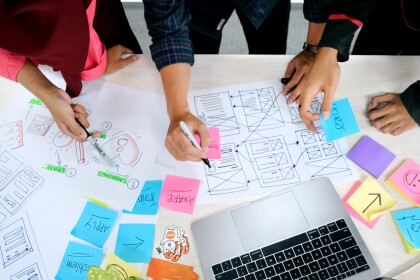
Skip the poetic descriptions. Even rough sketches or low-fidelity wireframes communicate far better than words ever will. Think visual first, verbal second.
2. Ditch the “Picture This” Language
For someone who can’t picture anything, that phrase can be alienating. Instead of “imagine a clean layout,” try “here’s one way this could look.” Concrete language builds shared understanding.
3. Prototype Early and Often
Don’t wait for perfection. Quick prototypes help people respond to what’s real, not what’s theoretical. You’ll get clearer, faster feedback.
4. Use Reference Imagery
Mood boards, screenshots, and visual analogies give everyone a starting point.
"Something with the warmth of Airbnb but the typography of Stripe.”
It’s not just useful, it’s essential for non-visual thinkers.
5. Compare Side-by-Side
Aphantasic individuals often find it easier to evaluate concrete differences than abstract possibilities. Two mock-ups side by side can unlock better feedback than any single “vision.”
6. Follow Up Visually
After meetings, include visuals in your notes, screenshots, examples, or snippets of what you discussed. “We agreed to make it more dynamic” means wildly different things to different brains.
7. Stay Curious, Not Frustrated
If someone’s feedback feels vague or slow, resist the urge to assume they’re indecisive. Ask for clarification, show more examples, and remember, they may be processing differently, not less effectively.
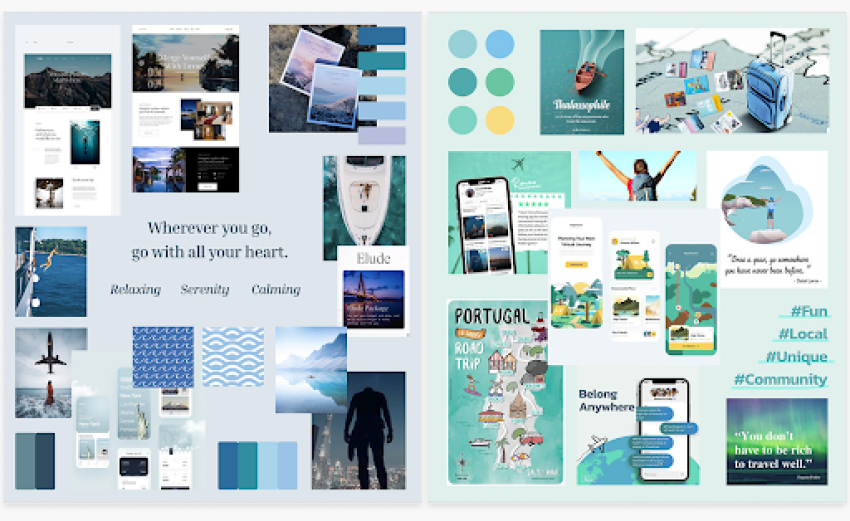
Neilson Norman Group: Mood Boards in UX: How and Why to Use Them
Designing with Aphantasia: How Visual and Non-Visual Thinkers Create Together
But here's a question that fascinated me as I dug deeper: what about designers who have aphantasia themselves? How do they navigate a profession that seems built entirely on visualisation?
Melanie Scheer, a book designer who studied at Bauhaus in Dessau, Germany, made this exact question the focus of her Master's thesis in Communication Design. Through workshops with fellow designers, she discovered something remarkable: visual imagination doesn't exist on a single spectrum. It's messier, more nuanced than that.
Some designers see crystal-clear images but can only hold them for a split second before they fade. Others see blurry impressions that persist. Some visualise in full colour, others prefer black and white. And some, like Melanie's friend Chris, see nothing at all.
What struck me most about Melanie's research was this: designers with aphantasia don't imagine less. They just externalise their imagination immediately.
Where a hyperphantasic designer might spend time mentally rotating an interface or "seeing" colour combinations before touching a computer, an aphantasic designer sketches first, prototypes first, builds mood boards first. Their imagination lives in the artifacts, not in their mind's eye.
And honestly? That's not a limitation. It's often an advantage.
Aphantasic designers tend to iterate faster because they're not attached to a perfect mental image. They're comfortable with ambiguity and refinement. They also tend to be excellent at systematising design decisions, because without the ability to "just see if it feels right," they develop frameworks, principles, and reference points.
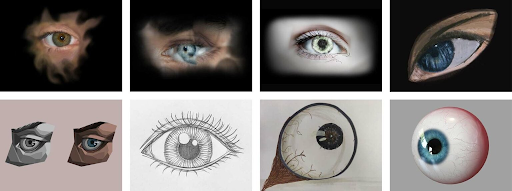
Melanie Scheer’s Visualizing the Invisible: Mental image they experience when hearing or reading the word “eye”
Aphantasia and Empathy in Design: Seeing the World Differently
Aphantasia is a fascinating neurological quirk, but the lesson for designers runs deeper. It’s about empathy in communication.
We tend to assume that everyone thinks like we do, that words like “vibrant,” “balanced,” or “minimalist” conjure the same mental images for everyone. They don’t. And that’s not a problem; it’s an opportunity.
When we design for diverse ways of thinking, not just diverse users, we become better communicators, collaborators, and creators.
The best design processes aren’t visual, verbal, or analytical. They’re flexible. They make space for how different brains imagine, process, and decide.
So next time you’re in a meeting and someone doesn’t quite “see” what you mean, maybe they literally can’t.
Take it as a cue to slow down, to show instead of tell, to translate imagination into something tangible. Because design, at its heart, isn’t about what we see in our minds, it’s about what we help others see in the world.
And honestly, that’s something worth picturing.