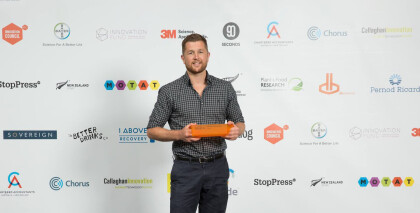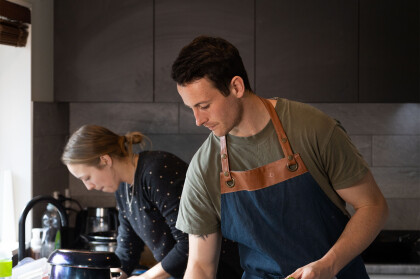
Born and raised in Christchurch, Camille moved to Australia in 2013 where she met her husband Stuart.
The pair landed in Vancouver, Canada in 2015 at the end of their honeymoon and stayed there for a decade before returning home to NZ with two young children in tow.
Now she is helping develop the angel investment community in Christchurch, using her experience as an angel investor community manager in Vancouver.
A former physiotherapist, Camille graduated from the Master of Business Administration programme at the University of British Columbia.
In January 2020, she was referred for a role with Valhalla Angels Vancouver as Vancouver chapter president, connecting angels and founders across the city at “the absolute peak” of venture capital (VC).
Camille learned a lot and quickly because, she said, she talked to about a thousand founders in her two years with the company.
“When you see that number of companies coming past your desk, you really do get a sense of what's good and what's not good.”
Bringing it home
After two years with Valhalla, Camille and Stuart had their first child and they decided to spend four months in Christchurch while she was on maternity leave.
While there, she fell back in love with the now-revitalised city where she grew up – a city that had gone through a lot and, she said, changed in a way she hadn’t expected.
“It was very different - and in the best way possible. A new freshness and wave of revitalisation had hit and it made us want to leave our North American home to come back to NZ”.
In 2024 CNZ, MAI and Canterbury Angels (CA) decided angel investing would be more effective if there was a larger angel group. Having a critical mass would make them more founder-friendly, more founder-focused and enable them to write bigger cheques. The merger process had a high level of collaboration - and has been very successful.
MAI had been active for some time around the Otago and Southland regions, with the current MAI network manager Peter Ramsay leading the charge in the main centres Dunedin, Queensland, Invercargill and Wanaka.
Entrepreneurial Experience
Peter and Camille, who have both been entrepreneurs themselves, have worked together to rapidly grow the level of investment in startups over the past 18 months, with the first financial year in the role total investments hitting $1 million. In the year following they reached $2.6 million.
With the country as a whole enduring an prolonged economic slump, Camille said it has been a tough fundraising environment but despite that, investors are still “leaning in”.
“They have some dry powder so there is cash available for the right businesses and the right story. Companies are growing, they're being successful. And I think investors care about the local economy – they want to see it succeed so they are investing in local companies. They're also coming back for another round because, like BioOra for example, they've increased their valuations 2.3x in six months.”
From Camille’s perspective, this demonstrates that there are Kiwis with money willing to help bolster the nation’s economy by investing in companies, rather than taking safer bets.
“They seem like people who have some really altruistic motives where they truly want to help the economy, help businesses, help New Zealand Inc thrive and grow.”
She explained that she tells potential investors about the high risk nature of the asset class, but that the real draw is not return on investment, but the feeling that they can help.
“These are often local start ups where you can shake the hands of the CEO and you can actually help in a meaningful way if this is something that you have expertise in. And they're willing to accept your help, which is often a huge pull.”
How to get your wings
Venture capital investors are often imagined to be fabulously wealthy with millions of dollars to put into a single cheque, the reality is actually quite different.
Those who meet the criteria can make investments of just $5,000 at a time. These small investments are aggregated into larger cheques that are then passed onto the startups.
While cheque size may be small, it all adds up as the average investment made into a startup is between $50,000 to $150,000.
In rare cases where investors truly get excited about a company, that number can rocket, such as the $960,000 invested in Queenstown’s In Game Collectables or the $800,000 for cancer treatment powerhouse BioOra.
Even with the small minimum investment, Camille said it can be a challenge to find local investors because New Zealanders tend to prefer to fly under the radar.
“No one has a sign saying, ‘Hey, I'm rich, come and find me!’. New Zealanders are so low key, you can't judge people by the way that they look or where they live.”
This means that while anyone with the risk appetite and capital is welcome to join MAI, Camille’s strategy for finding new investors has become more targeted.
“The types of investors that I'm thinking about are obviously well capitalised, some sort of startup experience is helpful, or a business that they've sold recently. They've had some real experience so that they can not only give the startup some cash, but also some expertise or mentorship.”
Fortunately, Camille has a team of 10 “champions” who keep their ears to the ground for future angels, flying the MAI flag and selling the “cool” factor of being involved in VC.
Those interested can attend one of the six yearly pitch events MAI hosts across Christchurch, Wanaka, Dunedin and Queenstown where investors and other interested parties gather to network and assess potential startups.
Putting the art in startup
While finding new investors is one challenge, on the other side of the coin is finding the right startups for them to invest in.
While there is a certain level of number crunching and grilling over ARR and CAC and other three-letter-acronyms, Camille said assessing the potential of startups and their founders is as much an art as it is a science.
As someone who has assessed more than 1,200 startups in her career so far, she leans more toward the artful approach.
“You develop this pattern recognition where you can sense who has a good understanding and way of explaining a very complex story to a very specific audience, which is me as an investor. There are definitely KPIs and definitely things that they need to hit in the story, but what sets them apart is that intuition and that gut feel.”
Camille spends a lot of time in and about the places where founders gather, such as the Ministry of Awesome headquarters, which she said allows her to keep a casual finger on the pulse and follow many companies on the journey toward being investment ready.
The size of the region also helps as news travels fast to those who are ready to listen.
“
“Being the size the South Island is, news travels fast; usually people hear what's going on through networks. Especially those seasoned operators who have started a company before, they usually have pretty extensive networks and people will talk … I'm all about the goss.”
But the passive approach only goes so far and Camille Hunt said she tries to live up to her name.
“I am very much a hunter, so I'm looking for opportunities to try and interact with the next generation of entrepreneurs and get my brand and MAI's brand very much out there. I’m always talking with universities, accelerators, trying to get involved with mentorship opportunities or speaking spots.”
And she sees plenty of good game emerging from the brush.
Encouraging outlook
Over the last year, MAI presented 25 different companies to its angel community and 16 of them received at least some investment from that $2.5 million.
The MAI team continues to grow investment in its core regions, and even outside of MAI’s primary investment areas Camille is seeing positive economic signs.
“We were talking to the Nelson Economic Development Agency and they said they talk to about 300 companies a year. We dug into that and probably about five to ten of them will be investment ready in a year, but that's a lot.”
Camille’s experience in the Christchurch investment scene has given her a sense of optimism that is hard to come by at a time when economic woe seems to be the status quo.
“When I came back a couple of years after the earthquakes in Christchurch definitely I felt that (heaviness) but (in 2024) it felt like there was this optimism and this revival in this city. This lightness, which was unexpected.”
Now, settled back into the city where she was born with a family of her own, Camille said her own mission statement is to make that city more successful, and she sees venture capital as a key driver.
“By activating the early-stage investor community, we can grow more successful businesses in our backyard and seed them so that they can grow into the next Rocket Labs or the next Dawn Aerospace. I think it would be great to be a part of that.”
The angel investment approach is particularly beneficial as it inherently builds community that is dedicated to economic growth.
“It's meeting other like minded individuals who also are passionate and interested in growing the economy and investing into companies, building relationships with them and then also learning from them. It is a really great community aspect because you're investing in companies that are local and you have this connection over the next ten years. You and I do a deal together and we will have that connection, we'll always have something to talk about.”
This ecosystem can be transformative and Camille said her experience returning to Christchurch has made her realise how powerful change can be.
“A city that I didn't think could transform has transformed, and I think can continue to grow and transform even beyond what it currently is.”